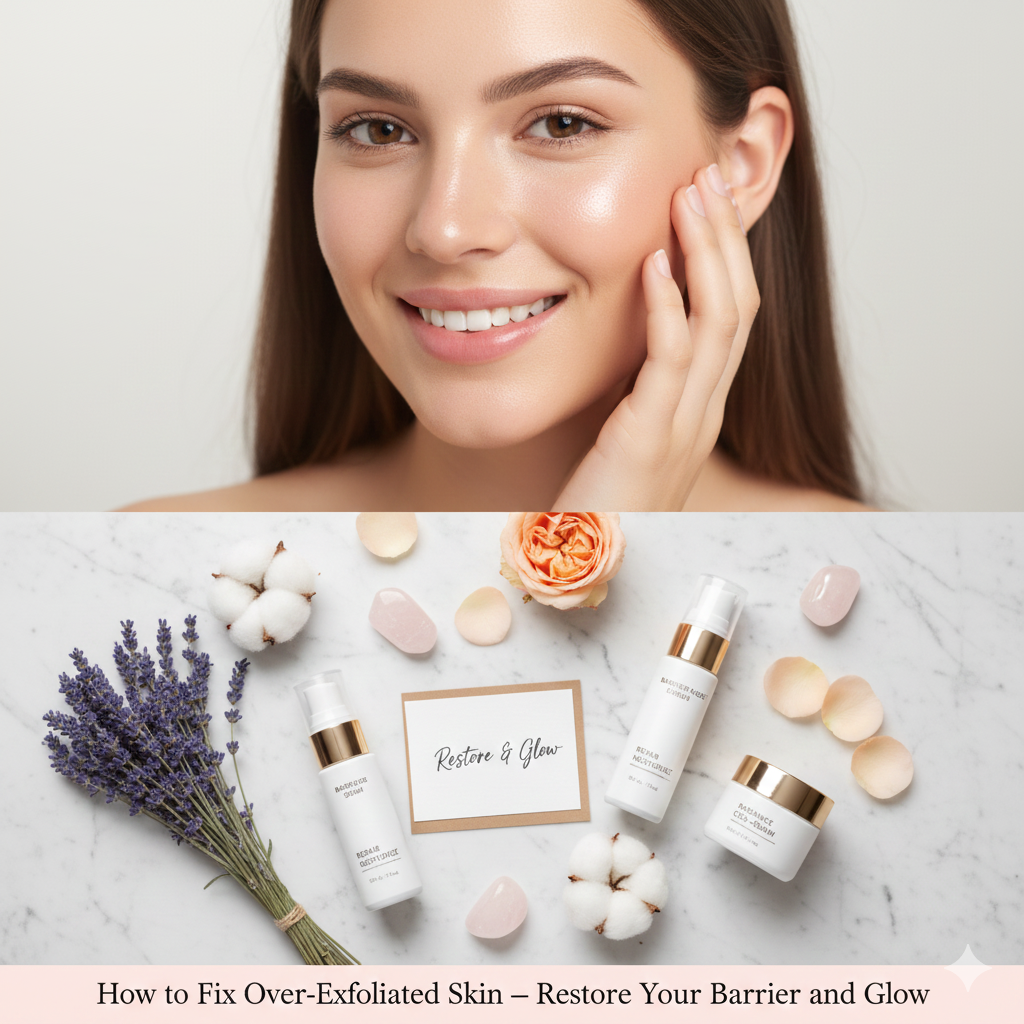
How to Fix an Over-Exfoliated Face: Step-by-Step Recovery Guide
Exfoliation is meant to give you smoother, brighter skin. But when you go too far — scrubbing too hard or using acids too often — your skin barrier can collapse.
The result? Redness, burning, peeling, and tightness that make your skin look anything but glowing.
If that sounds familiar, don’t panic. With a few careful steps, you can restore your skin’s balance and protect it from further damage.
This guide walks you through how to repair an over-exfoliated face safely and effectively, based on dermatological advice.
1. Stop All Exfoliating Products Immediately
Your first move is simple: stop all exfoliation.
That means:
- No acids (AHA, BHA, PHA)
- No scrubs or cleansing brushes
- No retinol, peels, or vitamin C serums
Every one of these ingredients weakens your barrier when it’s already fragile.
Instead, focus on letting your skin breathe and rebuild itself naturally.
💡 Tip: If your skin stings when you apply moisturizer or even water, that’s a clear sign your barrier is compromised.
2. Switch to a Gentle, Non-Stripping Cleanser
Cleansing is still important, but choose wisely. Avoid foaming or gel cleansers with sulfates, acids, or alcohol — they strip your natural oils even more.
Look for formulas labeled “hydrating” or “barrier-supporting,” ideally with:
- Ceramides
- Glycerin
- Panthenol (Vitamin B5)
- Allantoin
A mild cream or lotion cleanser, used once daily (at night), is usually enough until your skin calms down.
3. Prioritize Barrier Repair and Moisture
This is the most important step. Your goal is to rebuild your skin barrier, which is made of lipids like ceramides, cholesterol, and fatty acids.
Choose a rich, fragrance-free moisturizer that mimics these components.
Look for ingredients such as:
- Ceramides + cholesterol + fatty acids
- Squalane
- Centella asiatica
- Niacinamide (2–5%)
If your skin feels very dry or sore, apply a healing ointment or balm (like one with panthenol or madecassoside) on top to lock in moisture.
4. Add a Soothing Recovery Mask
Masks can provide relief and hydration, but choose only calming, non-exfoliating formulas.
Good options include:
- Aloe vera gel masks
- Oatmeal or cucumber masks
- Green tea or chamomile
- Barrier-repair overnight masks
Avoid clay masks, peel-offs, or anything labeled “brightening” — these can make irritation worse.
5. Avoid the Sun and Always Wear SPF
An over-exfoliated face is more sensitive to sunlight, which slows healing and increases the risk of pigmentation.
Use a broad-spectrum SPF 30+ daily, even indoors.
Mineral sunscreens with zinc oxide or titanium dioxide are the best choices because they’re less irritating.
💡 Tip: Reapply every 2–3 hours if you’re outside, even on cloudy days.
6. Simplify Your Routine — Less Is More
Until your skin recovers, avoid layering too many products.
Keep your skincare simple:
Morning:
- Gentle cleanser
- Moisturizer
- Sunscreen
Evening:
- Cleanser
- Moisturizer (or balm if needed)
That’s all your skin needs right now.
7. Slowly Reintroduce Actives
After 10–14 days — or once your skin feels calm and no longer stings — you can slowly start adding active ingredients again.
Step-by-step approach:
- Begin with niacinamide (2–5%) for barrier support.
- Wait a few days, then try PHA or lactic acid (the mildest exfoliants).
- Add retinol only after several weeks, and buffer it with moisturizer.
💡 Never combine acids and retinoids in the same routine while recovering.
8. Strengthen Your Skin Long-Term
Once healed, maintain your results by:
- Limiting exfoliation to 2–3 times per week
- Avoiding mixing too many actives at once
- Hydrating every day
- Using SPF without fail
This not only prevents over-exfoliation but also keeps your complexion balanced and radiant.